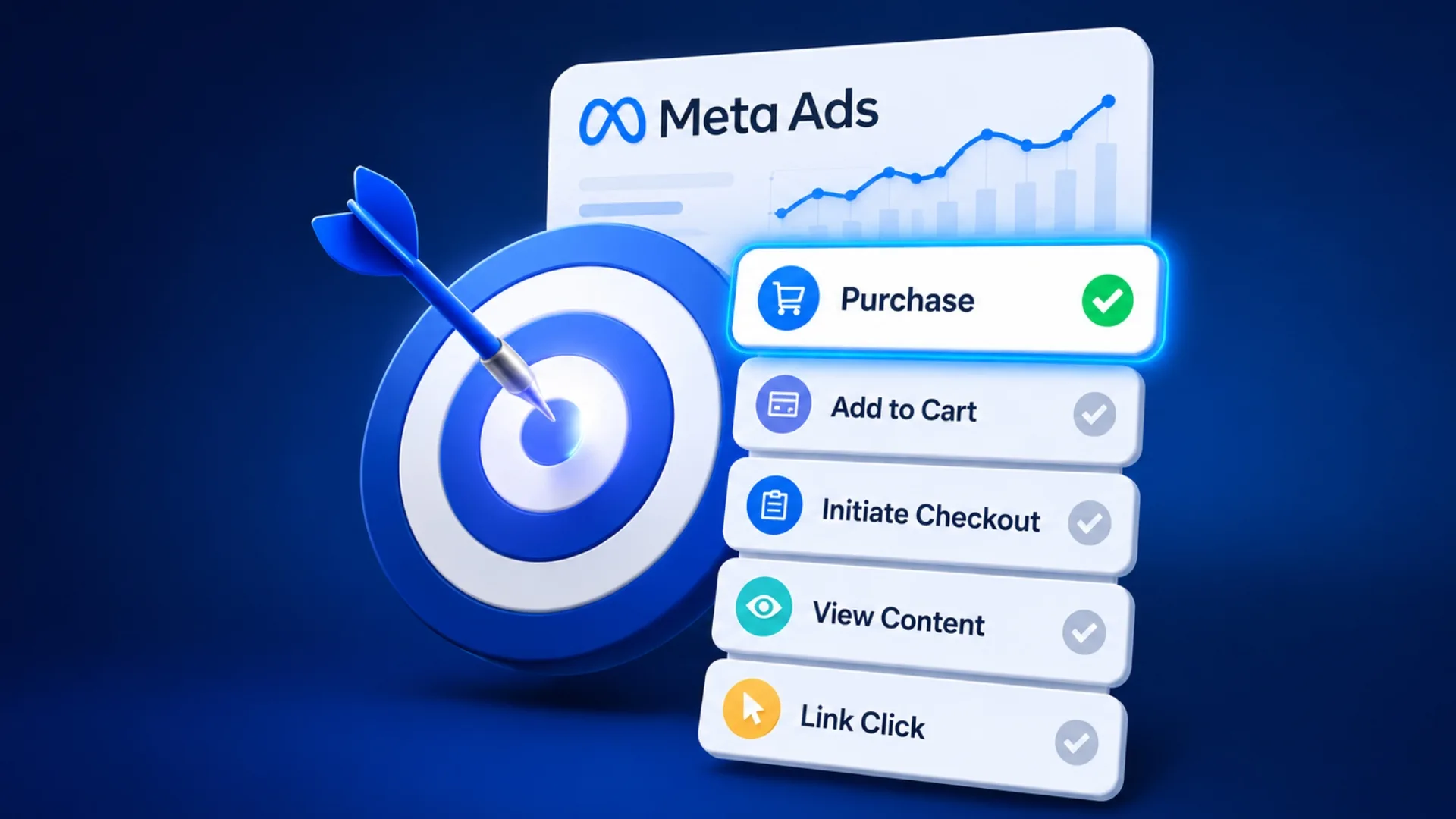
If you run Meta ads for an offer where the purchase doesn't happen right away, a free trial, a booked treatment, an application that takes weeks to fund, then you have to be wise about how you tell Meta to find you more people who will actually buy from you.
And that comes down to one choice: the conversion event you optimize for.
Pick the wrong one and Meta spends your budget bringing you people who never pay. Pick the right one and it goes hunting for buyers.
Most advertisers pick the wrong one without realizing it, then blame everything except the setting that caused it.
Meta only finds buyers when you feed it buyers
Start with how Meta actually works, because when you understand how Meta works, you can optimize it to find you more people that will buy from you.
Meta finds more people like the ones who convert. You hand it a conversion, it studies who that person was and where they came from, and it goes looking for more of them.
That feedback loop is the whole engine. So the instinct is to feed it the most important conversion you have, the sale, and let it chase that.
That works when the sale happens fast. It breaks when the sale happens later.
Meta can only learn from conversions it sees inside its attribution window which lasts seven days from the moment the customer clicked on an ad.
Now picture a trial that converts on day fourteen. An appointment three weeks out. A loan that funds in two months.
By the time the money arrives, the window has closed and the click is cold. The purchase fires, but Meta has nothing left to attach it to.
So optimizing for the sale doesn't feed the algorithm. It starves it.
Optimize for the thing closest to the sale
So if you can't feed Meta the sale, feed it the next best thing.
The move is simple. You stop optimizing for the purchase and start optimizing for an action that fires earlier, inside the seven day attribution window, while the click is still warm.
This means you optimize for the action closest to the sale. And in cases like this, that is the strongest buyer signal you can give to Meta during the trial or waiting period.
But there is a trap in how people do this, and it is the whole difference between leads that buy and leads that waste your money.
Make them prove intent, not just hand you an email
Here is where most people go wrong, and I see it constantly. They optimize for the first easy thing that fires.
Someone starts the free trial. Someone downloads the lead magnet. Someone fills in the signup.
The dashboard fills up and it feels like progress, but none of it proves intent.
Starting a free trial or grabbing a free download is the easiest thing a person can do, and the easiest thing tells Meta nothing about whether they will ever pay you.
So you engineer the step that sits closest to the sale for your situation. If your free trial lets them create an account, don't stop at the signup.
Make them log in, and make them actually run the core function your software was built to do.
The moment someone uses your product is the moment they show real intent, and that is the action you hand to Meta.
Optimize for that, and the algorithm starts hunting for people who behave like buyers instead of people who just sign up and disappear.
Two rules keep that action useful. It has to be doable inside the seven-day attribution window, because anything a person finishes after the window closes is something Meta can't optimize for.
And it has to be something most of your users will actually complete, not just your most committed few, so get as close to the sale as you can while still picking an action the majority will finish in time.
What that action actually is depends on what you sell.
Here are some examples of what this looks like
Take software with a free trial that converts on day eight or fourteen. The charge is outside the window, so you can't optimize for it.
The easy event is the free signup, an email and a password from someone who might never open the product again.
The deeper action is what a real buyer does inside the trial. They log in a second time. They finish the account setup. They run the first real thing the software is built to do.
Using it is the signal, so that is what you optimize for. A subscription app is the same shape, you optimize for the activation milestone, not the day-seven charge.
Take an appointment business, a med spa, a dental practice, a clinic. The sale is the visit, weeks out and outside the window.
The easy event is the booked appointment, and you know how that goes, people book and ghost.
So reach for the closest thing to the transaction you can get them to do before they walk in. A completed intake form. Photos of the area or the issue uploaded. A health questionnaire filled out.
The point is you make them invest something real before the visit, because a no-show won't bother and a real patient will.
Then there is the application funnel, insurance, loans, mortgages, debt relief, solar. The sale, a funded loan or an approved policy, is weeks to months out.
The easy event is the quote request, a zip code and an email, and it is almost pure junk.
The deeper action is the completed application. The full form. Documents uploaded. A bank connected. An e-signature on the line.
That is a real applicant with skin in the game, not a price-shopper killing ten minutes.
These aren't standard events, so you build them
Look back at what actually proved intent. The second login. The completed intake. The uploaded documents.
None of those are on Meta's standard event list. Purchase is there, Lead is there, but there is no built-in event for someone who uploaded their pay stubs or ran their first report.
So you build it yourself, as a custom conversion fired through the pixel and CAPI, pointed at the exact behavior you have decided is proof of intent.
You can even start firing it now, while you optimize for something else, and let Meta train on it until it becomes the event worth optimizing for.
The whole thing in one line
So the next time you set up a campaign for anything where the money comes later, don't start with the event list.
Find the action closest to the sale that a real buyer takes inside the attribution window, make it something they have to prove, and optimize for that.
Send Meta that signal, and it stops guessing at who your buyers are and starts going out to find them.