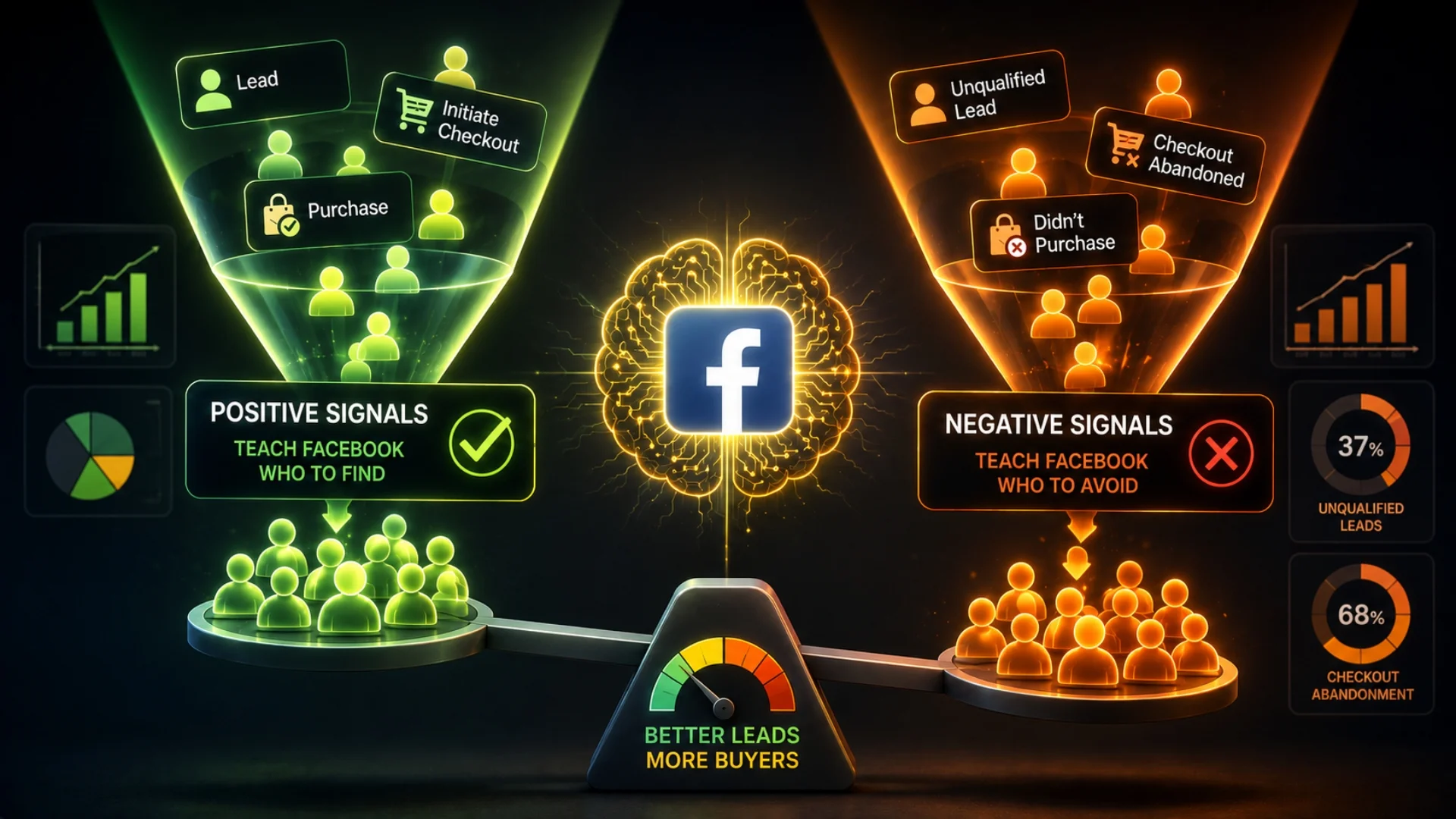
Every event you fire teaches Facebook something.
A lead event says "find more people like this." A purchase event says "this is what a buyer looks like." An initiate-checkout says "this person was interested."
All positive signals. All telling the algorithm what good looks like.
But here's what most advertisers never think about: Facebook has no concept of bad. You never told it.
What happens when the algorithm only hears the good news?
When an unqualified lead comes in and you fire the lead event, Facebook counts that as a win. It goes and finds more people like that person.
When someone hits your checkout page and bounces without buying, Facebook never hears about it. As far as the algorithm is concerned, that person doesn't exist.
So the algorithm keeps bringing you more of the same. More unqualified leads. More window shoppers who get to checkout and disappear.
And you keep wondering why your lead quality is dropping or why your checkout abandonment rate keeps climbing.
You blame the creative. You blame the audience. You swap offers. Nothing moves, because the inputs the algorithm is learning from haven't changed.
The fix: fire events for the bad stuff too
The fix is simple but almost nobody does it.
Fire events for the bad stuff too.
For lead gen
If you run lead gen and you qualify your leads, whether manually, through a sales call, or through a form, fire a custom event for the ones that don't qualify.
Now Facebook has two signals instead of one. "This person was a good lead" and "this person was a bad lead."
You can build exclusion audiences from the bad leads.
But more importantly, over time, the algorithm starts to see patterns in who doesn't convert and it deprioritizes those profiles in prospecting.
That's the move most advertisers miss. Exclusion audiences only stop you from re-showing ads to the same bad lead.
Negative signals change who Facebook brings you in the first place.
For e-commerce
Same thing for e-commerce. If someone visits your checkout page and doesn't buy, fire a custom event for that.
Not just a page view. A deliberate "checkout_abandoned" event that you send back through the Conversions API.
Page views fire for everyone, including people who land and bounce for unrelated reasons.
The signal needs to be specific to "got to the buying step and walked away," because that's the behaviour you actually want the algorithm to learn from.
Most people just retarget these abandoners with another ad. That's fine.
But you can also use that data to teach the algorithm something: people who look like this get to checkout but don't pull the trigger.
Over time, Facebook factors that into who it shows your prospecting ads to.
You're not just retargeting. You're reshaping prospecting
You're not just building a retargeting audience. You're shaping how the algorithm prospects for you.
Think about it this way. Right now, you're teaching a student but only showing them the right answers.
They'll learn eventually, but slowly and with a lot of mistakes along the way.
If you also show them what wrong looks like, they learn faster. That's what negative signals do for the algorithm.
Give it the full picture
Most ad accounts are running on half the data they could be. All positive signals, zero negative ones.
The algorithm is doing its best with an incomplete picture.
Give it the full picture. Tell it who's good and who's bad. Let it learn from both.