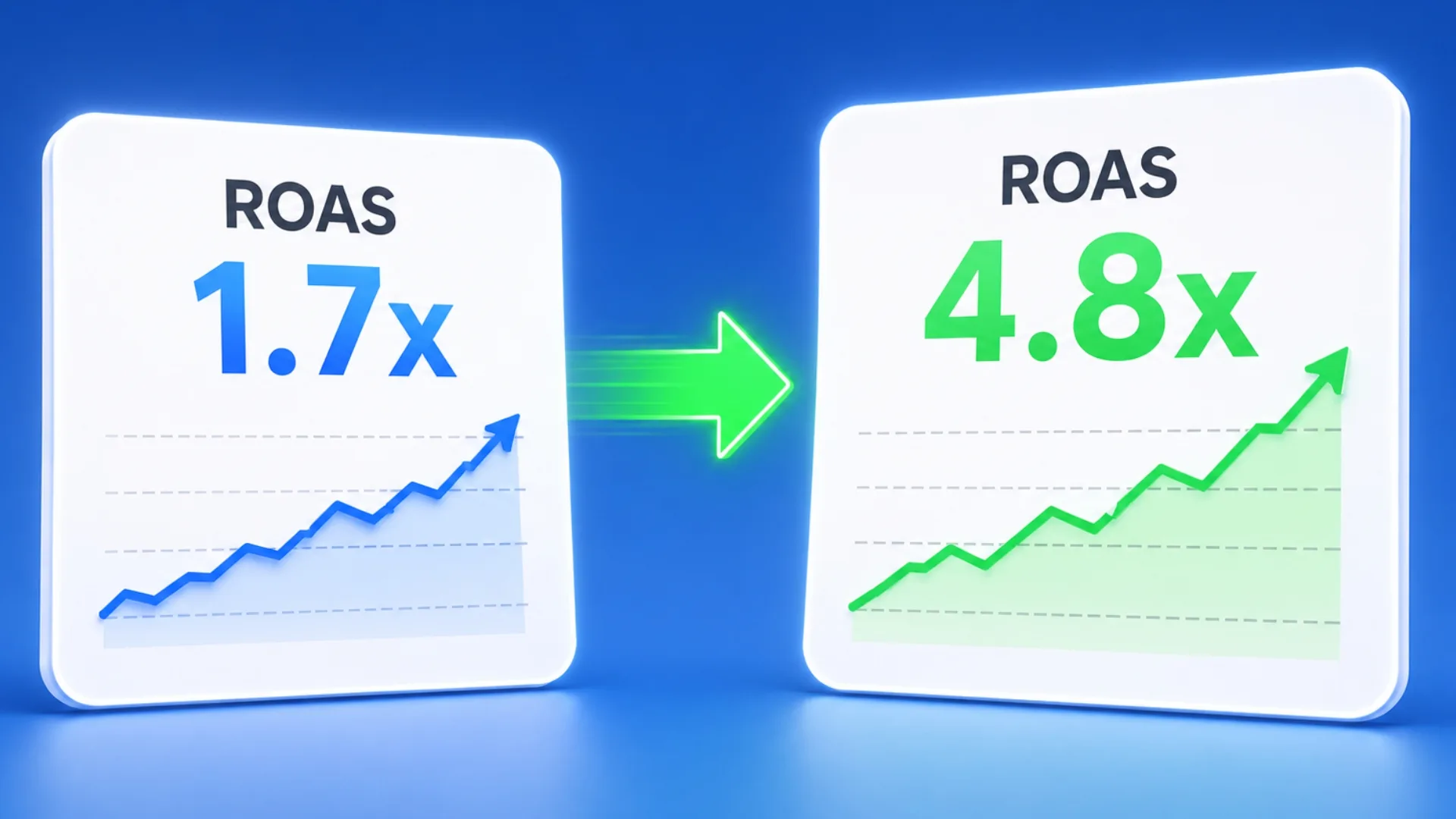
If you've been running ads for a few days and they're finally performing, you already know the next thought. You want to scale. More budget, more sales.
But your finger hovers over the budget field, because something tells you that the moment you touch it, the ads will stop working and the performance will go down.
It doesn't matter if you're spending $10 a day, $100 a day, $1,000 or more. The question is the same.
How do you raise the budget without breaking the performance you already have, or at least without breaking too much?
Maybe you've tried before. At $10 a day you were pulling 5 sales a day, reliably, like clockwork. So you jumped to $100 a day, expecting more.
Instead, 2 or 3 days went by without a single sale. Then 1 came in. Then a couple. Then another dry streak.
The performance fell apart at the bigger budget, and you wondered what you did wrong.
So, what's the solution?
Everyone's answer is the same. Scale slowly, 10-20% a day. It's correct.
But it never tells you why performance breaks, or what sets the limit on how far you can go. That's the part that matters, so let's start there.
Count conversions, not days
First question most advertisers ask: is a few days of data enough to scale on? Get this wrong and you'll raise the budget on something that was never really proven.
The instinct is to count days, and 5 days of positive ROAS feels like a green light. But days are the wrong unit.
5 days at 40 purchases a day is a mountain of data. 5 days at 2 purchases a day is almost nothing. Same calendar, completely different picture.
The algorithm doesn't learn from the calendar. It learns from conversions, and only from the ones that actually get reported back to it.
Meta needs around 50 conversions a week per adset just to get out of the learning phase. If you're well under that it's still guessing, and no bigger budget can fix what Facebook doesn't know.
So stop counting days and start counting conversions.
The ad eating your budget is the plan, not the problem
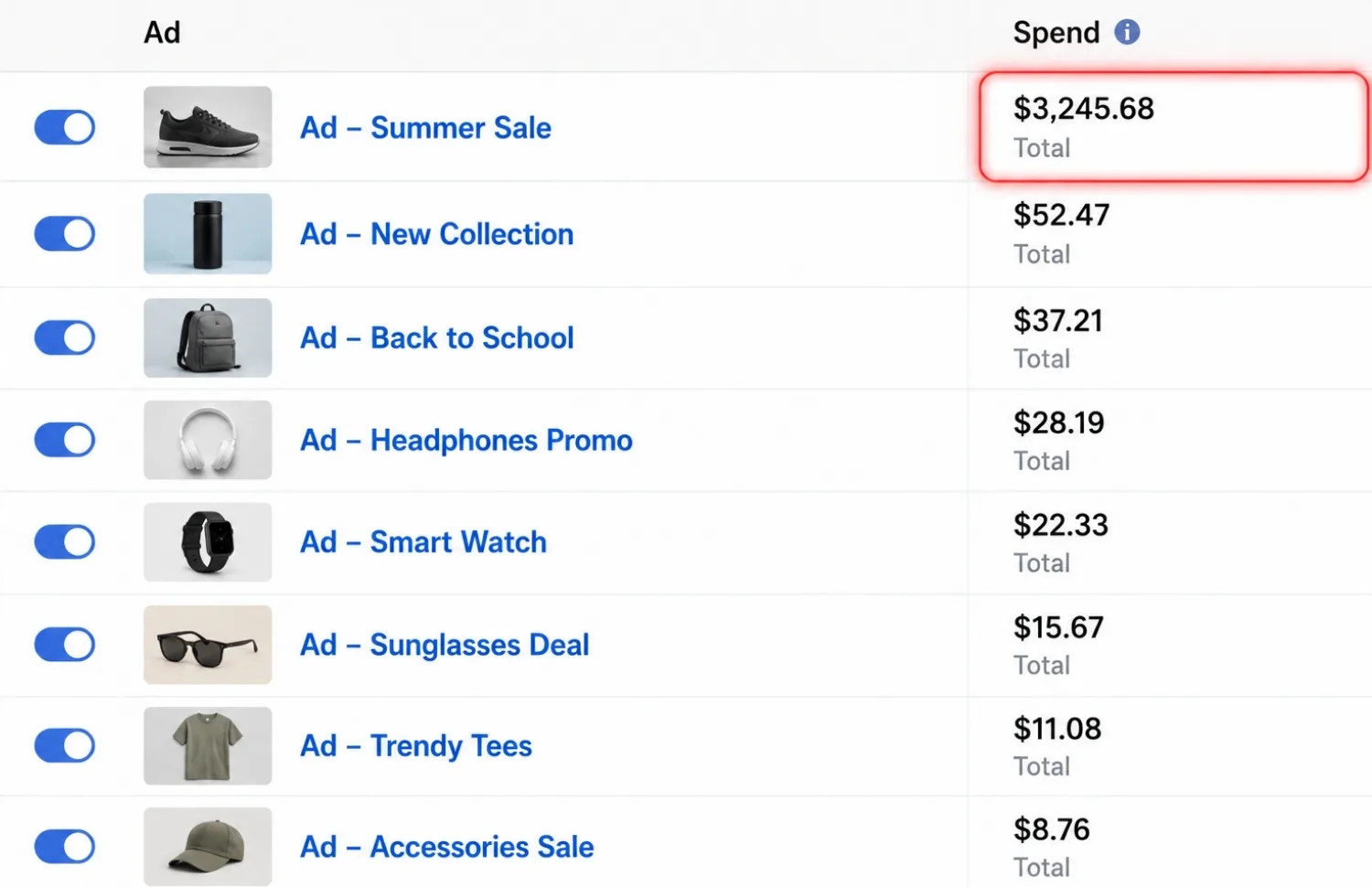
Now the thing that makes people nervous right before they scale. You've got 8 ads in the adset, and 1 is eating up 95% of the spend while the rest barely register.
Shouldn't the budget be spread more evenly?
No. That concentration is the algorithm doing exactly what you want.
It tested your ads, found the one that converts, and it's pouring spend behind the winner. That's the plan working.
The trouble starts when people try to fix it. They split the budget, add adsets, cap the winner.
Every one of those moves pulls spend and data away from the ad that's converting and scatters it across ads that already proved they don't.
If you want to test new ideas, and you should, do it in a separate campaign and leave the winner alone.
The ad eating your budget isn't a bug to fix. It's the winner to scale. Assuming it's bringing sales with a positive ROAS.
Why cost per purchase increases when you scale
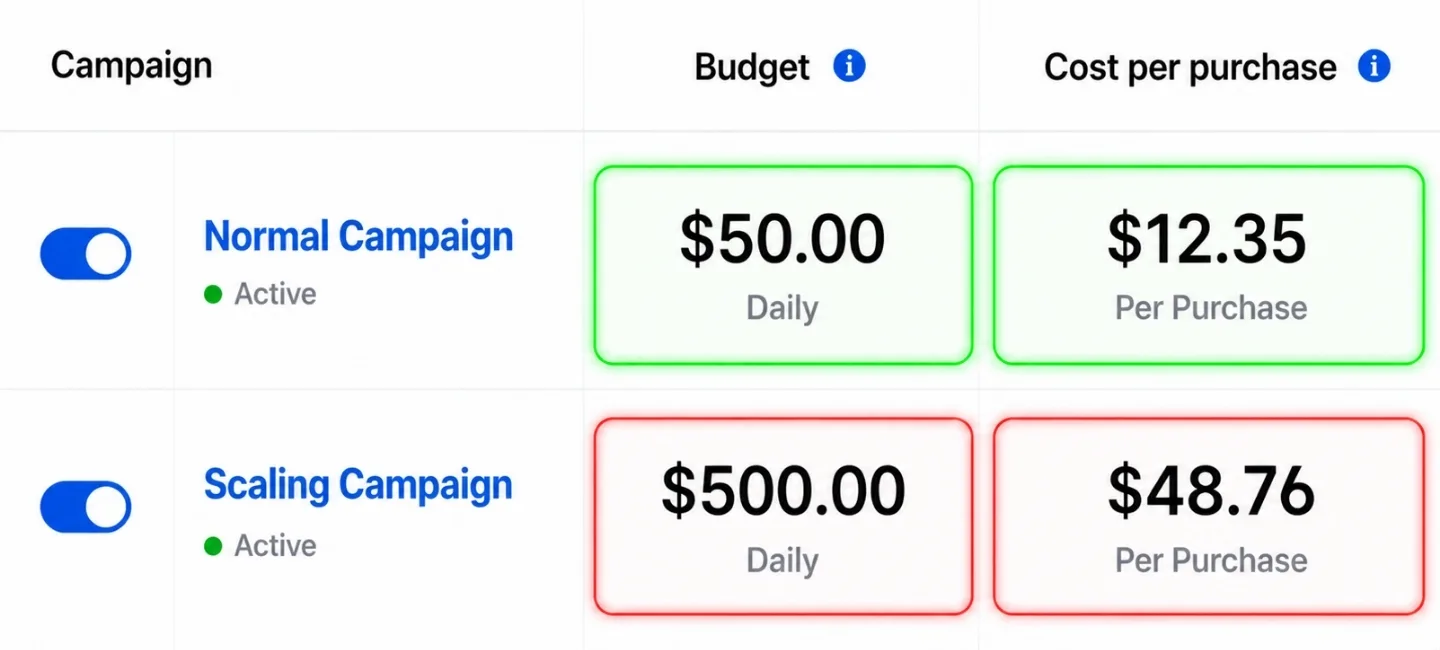
Underneath it all sits the real fear. You raise the budget and your cost per purchase climbs.
Most people picture a shelf of cheap buyers that Facebook runs out of. That's not it. There are more buyers than you could ever exhaust.
The real constraint is finding more of them at the same performance. At $30 a day the algorithm only has to find a handful of your best-fit buyers, so it can be picky.
Triple the budget overnight and to spend that money it has to reach past the tight-fitting audience into people who are not the perfect match for your offer. Not a perfect match means higher cost. That's the issue.
Small increments change that. Raise the budget 10-20% and you give the algorithm room to find the next batch of good-fit buyers without rushing into worse ones.
That's the whole reason the slow-scaling rule exists.
The one thing every scaling rule depends on
So the mechanics are simple. Count conversions, scale the winner, go slow. But all of it quietly rests on one thing nobody mentions.
Look at what each rule assumes. Count conversions assumes the conversions are counted accurately. Scale the winner assumes the algorithm knows which ad actually won.
Go slow assumes it can hold performance as volume grows. Every rule leans on the same hidden thing: that the tracking data you're feeding the algorithm is complete, accurate, and recent.
This is the pattern I see over and over in real accounts. The advertisers who hit a scaling wall almost never have a budget problem.
They have a tracking problem. Their conversion data was already thin at low spend, but low volume hid it, so everything looked fine.
Then they bump the budget, the algorithm suddenly needs far more matches than a bad tracking setup can supply, and performance falls off.
Scaling doesn't create the data problem. It exposes it. The gap was always there. Higher spend is just the first time it's big enough to see.
The real ceiling: what's getting back to the algorithm
So what does complete, accurate, and recent tracking data actually mean? It comes down to what the algorithm receives every time someone buys.
Who bought, what is the email tied to that person. Which ad they came from, what is the click ID that traces the sale back to the exact ad that earned the sale.
And it needs that sent back fresh, while the data still matters.
At $10 a day the algorithm only needs a little conversion data, so even with broken tracking the gaps never show. Push to $100 a day and the math flips.
Now it needs a lot more, and every missing email, every untracked click, every late or missing piece of data is a hole it fills by guessing.
The gaps stop being a rounding error and become the ceiling.
That's why the fix is never just a smaller increment. You can raise the budget 5% a day and still hit the wall, because the wall was never about pace.
The real question the next time performance breaks
So the next time you scale and watch performance break, notice which question you reach for first.
Most people ask "did I go too fast?" The question that matters is what you were feeding the algorithm before you ever touched the budget.
Get that right, and scaling stops being the thing you're afraid of.