When you run ads, the thing that actually decides whether they work is not the creative and it is not the audience.
It is whether the conversion data makes it back to the ad platform.
And there are two things that carry most of the weight for the data you report back to Facebook and Google.
The first is the buyer's information, the email and the details that tell the platform who just bought.
The second is the click ID, the tag that ties that buyer to the exact ad they clicked.
Send both cleanly and the algorithm learns. Miss them and it guesses.
Apple has spent the last few years making one half of that harder to send.
Apple has been making this harder for years
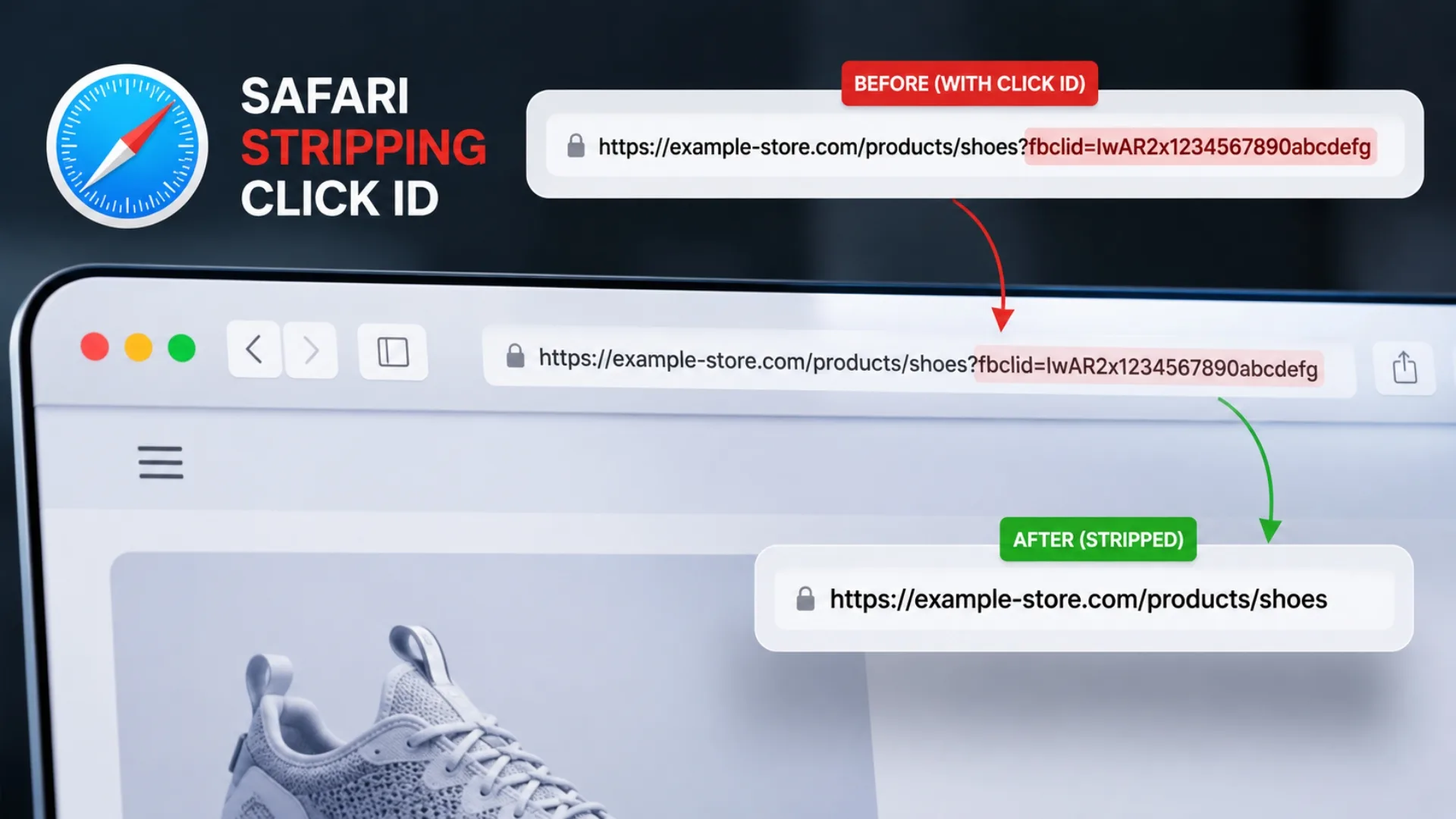
Since 2023, Apple has been rolling out features in Safari that strip the click ID out of links.
At first it stayed contained. Open a link from the Mail app, from Messages, or in a private browsing window, and the click ID was quietly removed before the page even loaded.
For a while that was the whole story, and most advertisers never noticed, because it only touched a slice of their traffic.
That changed recently. With iOS 26, Apple announced it is starting to bring the same stripping to normal browsing.
It is not the default for everyone yet, but the direction is set and they have already started moving.
The version where every Safari visit arrives with no click ID at all is no longer a question of if. It is a question of when.
What that actually does to your tracking
Here is what it looks like in practice. Someone clicks your ad, and the link that loads carries the click ID on the end of the URL.
Then Safari steps in and removes it before your site ever sees it.
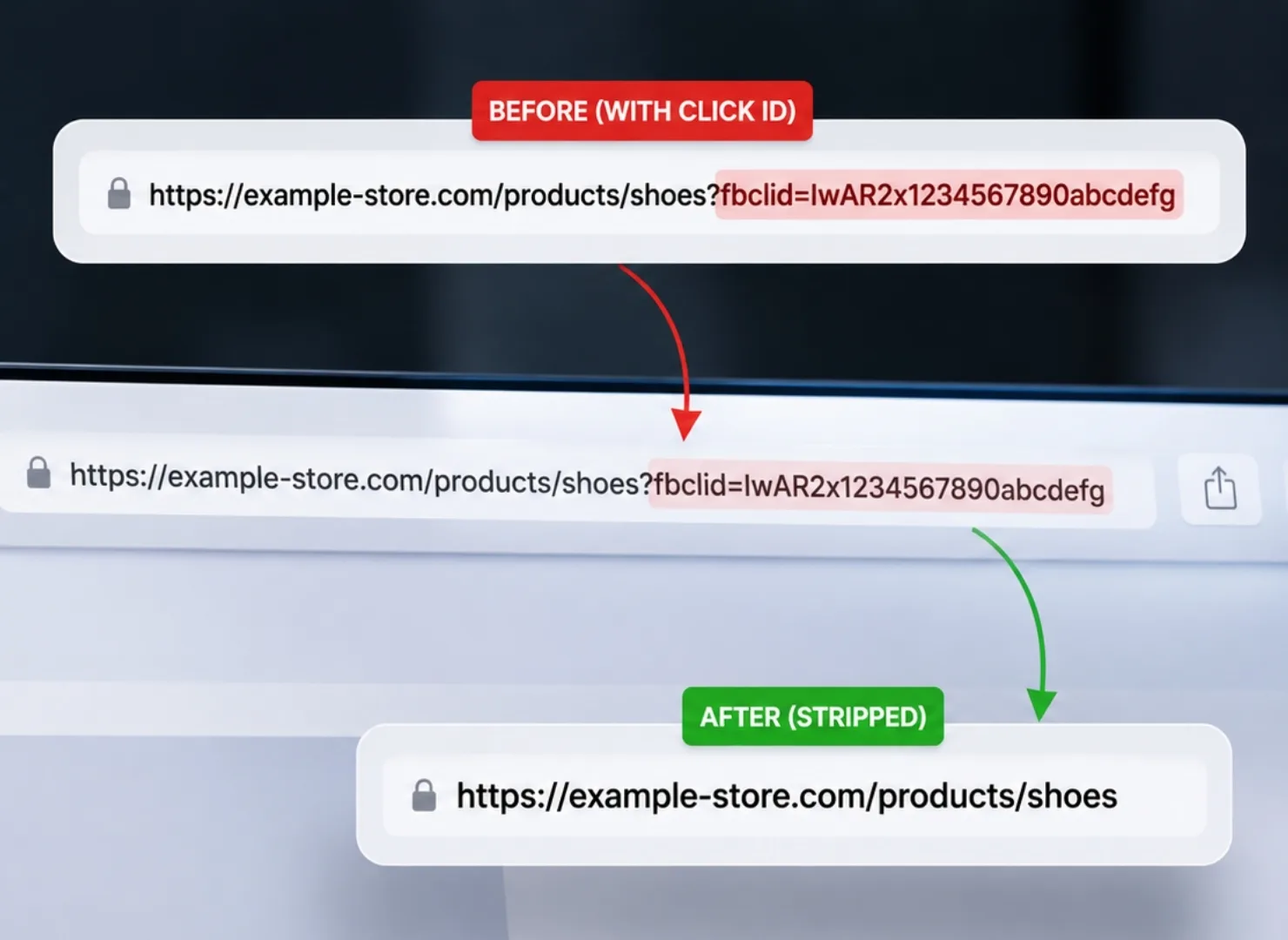
Now play it forward. The sale still happens, and you still send the conversion back to Facebook.
But the click ID is gone, so Facebook cannot tell which ad earned it. The purchase arrives with no return address.
It gets logged as organic, or handed to the wrong campaign, and the algorithm loses the signal it needs to optimize.
Stack that across every Apple device in your funnel and a real chunk of your revenue gets mislabeled while your reports quietly tell you the wrong story.
And this is not only a Facebook problem. Google runs on the same kind of click ID, so Google has the same issue.
Google gave advertisers a way out
Google's fix works because of how the stripping actually happens. Safari does not read what a parameter does. It matches the name.
It keeps a list, gclid for Google and fbclid for Facebook, and it deletes anything on that list.
So Google lets you put the click ID somewhere Safari is not looking.
Using a setting called a ValueTrack macro, you copy the click ID into a parameter you name yourself, something Safari has never heard of.
The original still gets stripped, but your renamed copy rides through untouched.
On your server you rename it back, and you hand Google a clean click ID. The data gets through wearing a disguise.
You set this once, at the account level. In Google Ads, open Admin, then Account settings, and open the Tracking section.
Whatever you put in the Tracking template field gets applied to every campaign and ad in the account automatically, with nothing to repeat per ad and no scripts to install.
The move that matters is the same one every time: copy the gclid into a UTM parameter of your own choosing, so it rides through under a name Safari is not watching for.
An example of what that can look like:
{lpurl}?utm_source=google&utm_medium=cpc&utm_content={gclid}The {lpurl} at the front is Google's macro for the landing page URL, so the template wraps whatever destination each ad already points to.
In this example the click ID rides inside utm_content, but that part is just a choice. You can carry it in any parameter you like, as long as it is not the gclid name Safari strips, then rename it back to the gclid on your server.
Facebook did not, but it leaned somewhere else
Facebook gives you no such option. There is no way to copy the fbclid into a parameter of your own, so there is no disguise to build.
On the click ID alone, Facebook advertisers are exposed.
But Facebook spent that time leaning harder on the other half of the round trip.
Instead of depending on the click ID to connect the sale to the ad, it leans on the buyer's information to connect the sale to the person.
This is advanced matching. You send the customer's details, the email, phone, name, and IP, and Facebook matches that conversion to a real account on its side, then works out which ad that person saw.
Facebook's own guidance names email, phone, name, and IP as its strongest matching signals.
The click ID is not even on that list.
So when it disappears, the match does not have to disappear with it, as long as you are still sending everything else.
The way to actually send it: server-side tracking
There is a catch. That information has to reach Facebook complete, on every single sale.
The pixel in the browser is exactly what Apple keeps interfering with, so leaning on it is leaning on the thing that is breaking.
The reliable way is server-side tracking, where the data goes to Facebook from your server instead of from the visitor's browser, out of Apple's reach.
This is what we do by default at TrueMetriks.
Across our clients we are not seeing the discrepancies or the performance drops that everyone else is bracing for, because the buyer's information goes back on every event without depending on the browser.
We do still watch the click ID get stripped for some clients from time to time.
And even in those cases, we can tell the visit came from an ad, and we send that back to Facebook so the ad still gets the credit it earned.
There is one more piece. When Facebook's own dashboard cannot show you which ad drove a sale, our Chrome extension can.
You see the ad behind the sale even when the platform has lost the thread.
Where this leaves you
Apple is not going to stop, and you will not get ahead by chasing the click ID every time they take it away.
The advertisers holding their numbers steady are the ones who stopped depending on it.
They send the buyer's information back to the platform from their own server, on every sale, so the match holds whether the click ID makes it through or not.
Set your tracking up that way, and Apple's next update stops being something you have to worry about.