Your Facebook Ads Manager and Google Ads dashboards are not showing you the real data.
They are showing you what each platform was able to see, scored by a model each platform picked for you.
Clicks inside their own walls. Not the clicks that happened outside them, and not in the order they happened.
Which leaves one question sitting underneath every budget decision an advertiser makes.
Where is the real customer journey hiding inside Facebook and Google Ads, and what would it look like to actually see it?
Why can't you see the journey?
The most important thing Facebook Ads Manager and Google Ads will never show you is not a number on the dashboard. It is the journey that produced the number.
And the longer that stays invisible, the more confidently advertisers spend money on the wrong half of what is working.
Picture the normal morning. You open Ads Manager, sort by ROAS, scan the top and the bottom.
The top gets more budget. The bottom gets paused or cut. The exercise takes ten minutes and feels like data-driven discipline.
What you are actually seeing is what each platform decided to call a conversion, based on what each platform was able to watch.
Not the path the customer walked. Just the verdict.
The journey is the thing that produced that verdict. The actual sequence of touches that brought a customer to the sale, in order.
Ad, then email, then organic visit, then retargeting hit, then ad again. Almost never a single click.
It does not matter whether the store runs on Shopify, WooCommerce, GoHighLevel, or something custom.
The blindness is not sitting inside your storefront. It is sitting inside the ad platforms, and a platform can only ever track what it sees.
So when advertisers say "Facebook is working" or "Google is dead," they are not describing what is working or dead. They are describing what showed up in the column.
Without the journey, no advertiser can honestly say what is working. They can only say what got the last click before the sale, and that is a very different case.
Why does the journey matter, and what is hiding it?
So the journey is the thing that matters most, and the thing nobody gets to see. The next question is the obvious one. Why is it hidden, and what is hiding it.
Skip this part and every other decision in the ad account is downstream of a model the advertiser never agreed to use.
On average, it takes around seven touches before somebody buys from you. The number is directional, not a law.
It moves with category, price point, and how cold the audience is. But the shape is consistent enough to plan around, and it is wildly different from one.
The model the platform uses to turn those seven touches into a single line of credit is called an attribution model. There are a few, and the differences matter.
First-click attribution gives 100% of the credit to the first ad the customer ever clicked. Last-click gives 100% to the final click before the sale.
Any-click attribution, which is the term TrueMetriks uses for the approach this post is heading toward, records and credits every click in the journey, in order.
Linear, time-decay, position-based, and data-driven are variations of the same idea, splitting credit different ways across the touches the platform can see.
Here is where the choice becomes a problem. Facebook uses last-click by default. Google moved data-driven to default in November 2023 and still offers last-click.
Data-driven sounds better, and in some ways it is, but it only weighs the clicks Google can already see.
The journey-invisibility issue does not disappear with the model upgrade. It just gets distributed more cleverly across a smaller view of reality.
One concrete example does the work here.
A customer sees one of your ads on Facebook and clicks. Call it Ad 1.
A day later they get an email from you and click a link inside it. A day after that, they see something on Instagram and click through.
Then they see another Facebook ad, click it, and buy. Call that Ad 3.
Under last-click, Ad 3 gets 100% of the credit. The first Facebook ad, the email, and the Instagram link are invisible.
Your dashboard shows one click. The actual journey had four.
That is not an edge case. That is the daily reality of an account that looks healthy on top and inconsistent underneath.
Last-click is not a measurement at all. It is a decision to throw away six out of every seven things the customer did before they bought.
Why can't this be fixed by changing a setting?
Facebook runs on a seven-day attribution window by default.
It credits a sale to a Facebook ad clicked within the prior seven days, and only the last click before the sale gets the credit. There is a one-day option, and it shows you even less, not more.
Google's default is data-driven attribution, which does split credit across multiple Google ad clicks on the way to a sale.
Inside Google's own ads, that works. But Google can only score the clicks Google saw.
An email open from Klaviyo, a TikTok retargeting tap, an organic search result, a friend's affiliate link, none of those live inside Google's view.
They cannot be credited in any Google setting, because Google never had them on the record.
Same on Facebook. Same on every walled platform.
You can change a setting inside the platform. The platform still only sees what it can see.
What does seeing the full journey look like?
Once you accept that the cap is structural, the question changes. It is no longer which click in the journey deserves the credit.
It is what it would look like to see every click in one place, owned by the advertiser instead of the ad platform.
That is the gap TrueMetriks was built to close. Three pieces.
The first is any-click attribution. Every click in the journey is recorded and visible, in the order it actually happened.
In the four-touch example from earlier, the Facebook ad, the email, the Instagram link, and the closing Facebook ad are all there. Every touch attributed, every position kept.

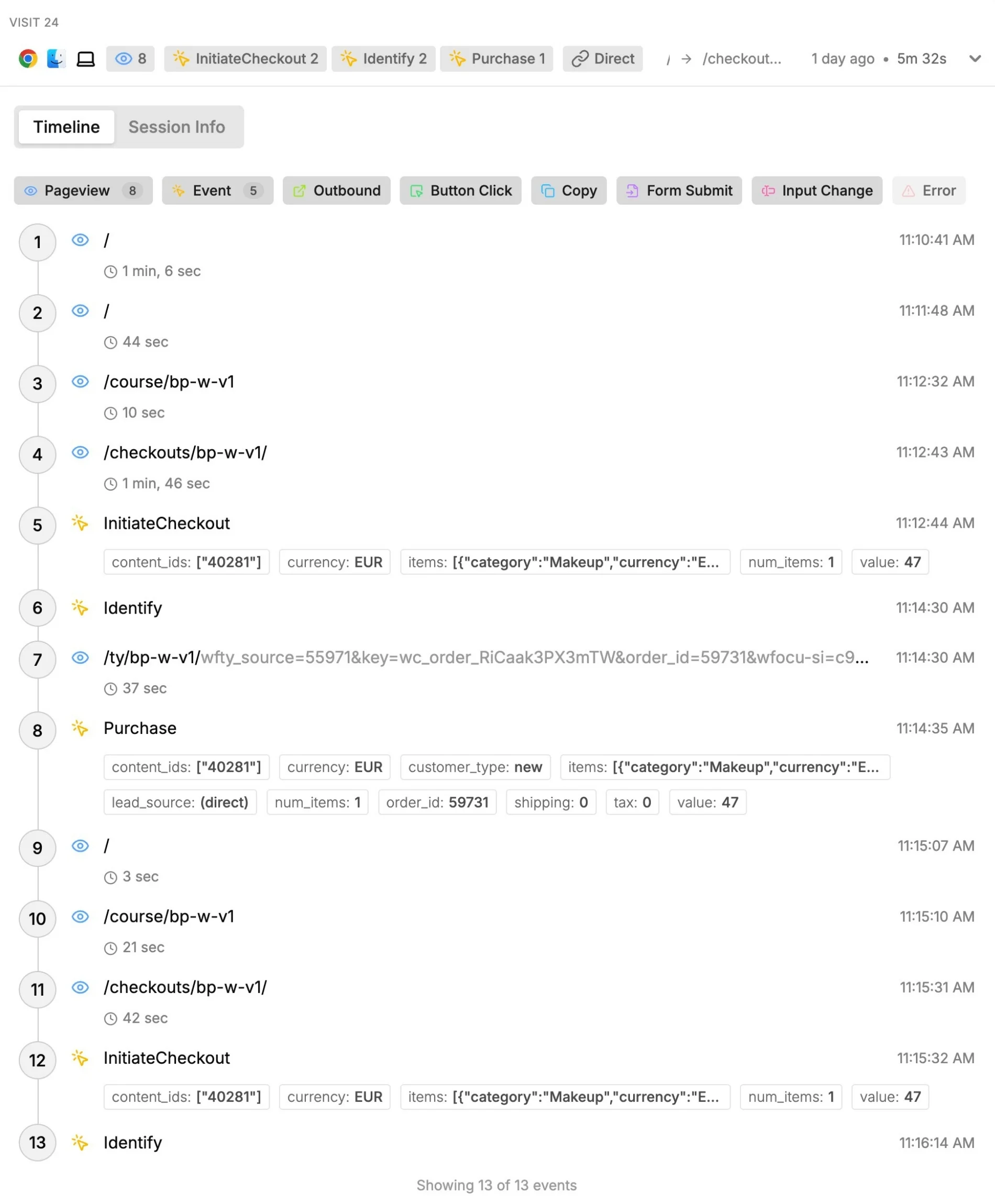
The second is a Chrome extension that surfaces this view directly on top of Meta Ads Manager and Google Ads.
The full-journey data shows up inside the dashboards where decisions are already being made. No separate tab to log into.

The third is cost broken down by customer type. The cost to acquire a new customer is separated from the cost to bring a previous customer back.
Last-click cannot split these, because it does not see the history behind the final click.
Why this matters is bigger than picking a winning ad.
Once the full journey is visible, you see the actual revenue a single ad pulls in over a longer window, not just the conversions assigned to it in a seven-day box.
The creative tests you run start telling the truth. The concepts that move new buyers, the formats that bring previous buyers back, the offers that pull both, all become clear.
It also stops being just a paid-ads story. The same any-click record covers email, organic search, affiliates, and every other channel feeding the same customer.
You stop tuning one campaign and start tuning the whole marketing operation.
Most advertisers think they are optimizing a campaign. They are actually optimizing the one click out of seven the platform happened to be looking at.
Once the other six become visible, optimizing the campaign and optimizing the journey stop being the same job.