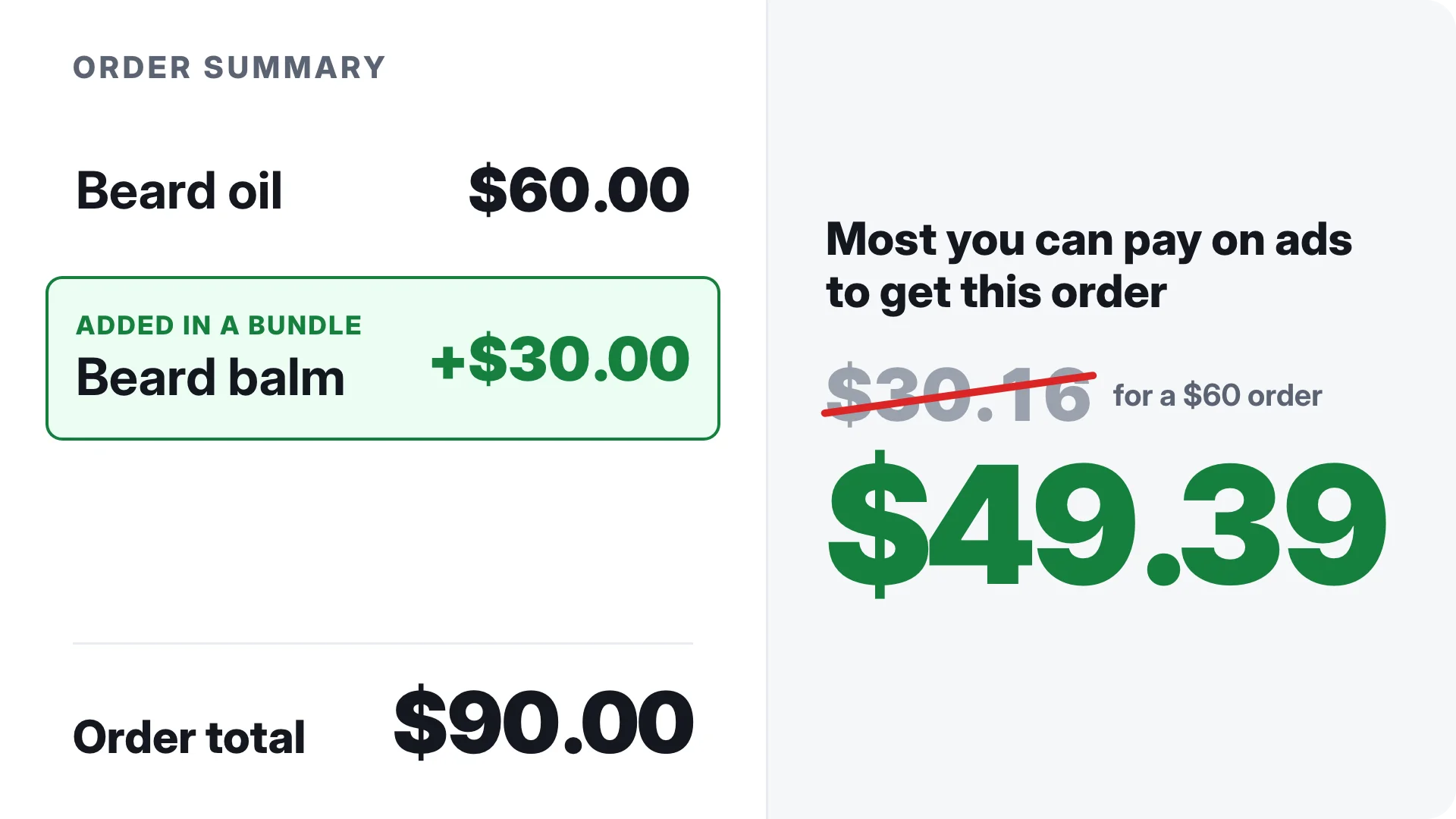
Here's what average order value (AOV) means, how to work it out properly, and why it decides how much you can spend on ads to get one customer.
The AOV meaning itself is one line of maths. What it does to your ads is the reason one store can pay $49.39 to get a customer while another store, selling the same kind of thing with the same costs, can only pay $30.16 before it starts losing money.
AOV meaning: what average order value is
AOV stands for average order value, the average amount a customer spends per order, and it's the number your ad budget gets built on.
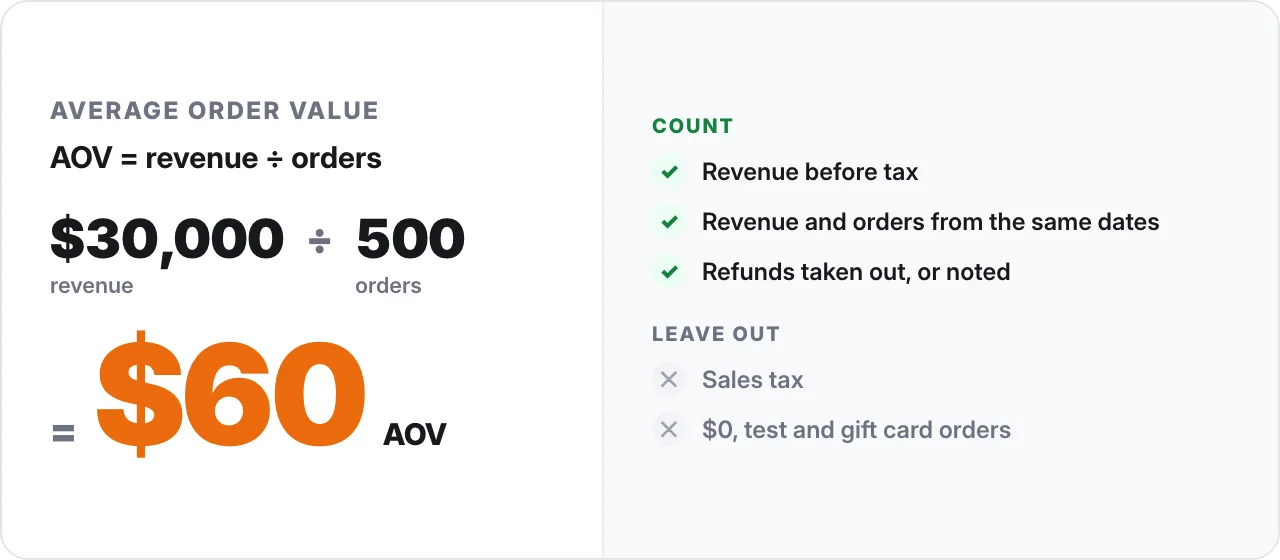
AOV = total revenue ÷ number of ordersWith example numbers, a store that made $30,000 from 500 orders last month has a $60 AOV, and that's the store we'll follow through this post.
Whether you see AOV in marketing, in business or in ecommerce, it's the same sum.
How to calculate AOV so your ad maths is right
Working out AOV is one division, but if the revenue going into it is off, every number you build on it is off too, including the most you can pay for an order.
Revenue pulled straight off a dashboard can have tax, shipping, refunds and test orders sitting in it, and each one moves the AOV.
Doing it properly looks like this:
- Revenue and orders come from the same period.
- For ad maths, use revenue before tax, and decide whether the shipping you charge the customer is in or out.
- Take refunds out, or note that they're in, the same way every time.
- Leave out $0 orders, test orders and gift card orders.
If you're on Shopify, its sales reports work AOV out like this, which leaves tax and shipping out and doesn't take refunds out:
Shopify AOV = (gross sales - discounts) ÷ ordersSome other Shopify screens describe order value with tax and shipping included, so check the definition on the report you're reading.
And even with all of that right, the number can still be the wrong one for your ads.
The AOV on your store dashboard is everyone's orders, repeat buyers and email orders included, and those orders tend to be bigger.
When we track orders by source for a store, the AOV of the orders the ads brought in often comes out lower than the store-wide number.
Plug the store-wide AOV into your break-even and the ads look like they can afford more than they can, which is how ads that look fine on paper end up losing money.
Seeing it takes tracking that tells new customers from returning ones and ad orders from email orders, which is what new vs returning customer tracking is for.
So for your ad maths, use the AOV of the orders your ads brought in, not the store-wide number on your dashboard.
Why AOV decides how much you can pay for a customer on ads
Which brings us to what AOV does to your ads, because it decides whether a sale from an ad makes you money or costs you money.
A lot of advertisers pick a target cost per purchase because it sounds reasonable or someone else pays it.
What should set it is what's left from each order after your costs, so here it is for the $60 store, with example numbers:
| Per order | Example numbers |
|---|---|
| Average order value | $60.00 |
| Product cost (30%) | $18.00 |
| Shipping | $8.00 |
| Payment fees (2.9% + $0.30) | $2.04 |
| Refunds (3%) | $1.80 |
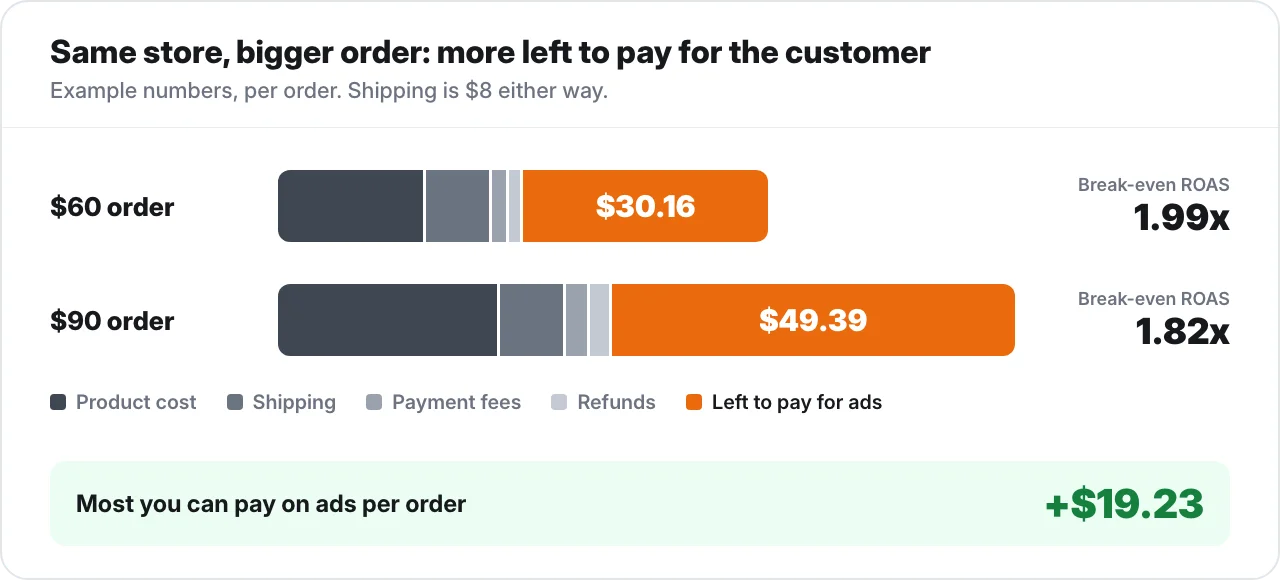
| Left per order before ads | $30.16 (50.3%) |
That $30.16 is your break-even CPA, the most you can pay in ads for one order. Pay more than that and every sale from that ad loses you money.
Turn it into a break-even ROAS and you get the number your ads have to beat:
break-even ROAS = AOV ÷ money left per order60 ÷ 30.16 = 1.99xSo the $60 store needs $1.99 back for every $1 of ads just to break even.
Now say it adds a bundle, a $30 item at the same 30% product cost that ships in the same box:
| Per order | Example numbers |
|---|---|
| Average order value | $90.00 |
| Product cost (30%) | $27.00 |
| Shipping | $8.00 |
| Payment fees (2.9% + $0.30) | $2.91 |
| Refunds (3%) | $2.70 |
| Left per order before ads | $49.39 (54.9%) |
90 ÷ 49.39 = 1.82xBreak-even CPA is now $49.39 and break-even ROAS is 1.82x, so with the same ads and the same store it can pay $19 more per customer and still break even.
The reason is shipping, which costs $8 whether the box holds one item or two, so it shrinks as a share of a bigger order and the money left goes from 50.3% to 54.9%.
Work out yours with the free break-even ROAS calculator.
A higher AOV raises the CPA you can afford, which means you can win buyers a lower-AOV competitor can't afford to bid for.
AOV vs ROAS vs LTV vs conversion rate
That break-even ROAS is where AOV gets mixed up with ROAS, LTV and conversion rate, and mixing them up is how an ad gets judged on the wrong number.
| Metric | What it measures | What it tells you about your ads |
|---|---|---|
| AOV | Average revenue per order | How much you can pay to get an order |
| ROAS | Revenue from ads ÷ ad spend | Whether the ads made back more than they cost |
| LTV | What a customer spends with you over time | What a customer is worth after the first order, but that's another post |
| Conversion rate | Share of visitors who buy | How many clicks it takes to get one order |
Plenty of people running ads judge an ad on its ROAS alone, but a ROAS only means something next to your break-even ROAS (the ROAS formula post has the full working).
Break-even is 1.99x for the $60 store and 1.82x for the $90 bundle store, so a 1.9x ROAS loses the first one money and makes the second one money.
ROAS and conversion rate tell you how your ads did, and AOV tells you how much they were allowed to cost.
What is a good AOV?
The question that comes now is what counts as a good AOV, and going by someone else's benchmark means setting your ad budget off their costs.
Well, it depends on what you sell and what you charge, so there's no universal number worth giving you.
An ecommerce average can't tell you whether your ads make money, because it doesn't know your product cost, your shipping or your fees.
A good AOV is one that leaves enough per order to pay for the ad that got the order, and for the $60 store that means its ads can cost up to $30.16 an order.
How to increase average order value without hurting your ads
Next up is raising AOV, and this is where it's easy to pick a tactic that pushes the AOV up and the room you have per order down.
A discount is the fastest way to see AOV go up, which is why a lot of advertisers reach for one first (more on that in a moment). These raise it and keep the room per order:
- Bundles. More product in the same box, so shipping is a smaller share and break-even CPA goes up (the $90 example above).
- A free-shipping threshold just above your current AOV, so a bit above $60 for this store. People add one more item to reach it, which works as long as that item covers the shipping you're now paying.
- Post-purchase upsells. Extra revenue on an order the ad already paid for, so the room per order goes up and the ad cost doesn't.
- Quantity breaks. Buying more than one spreads shipping and fees over more product, as long as the price drop stays small.
- Raising prices. The cost to get the order stays the same and the money left goes up, so break-even CPA goes up with it.
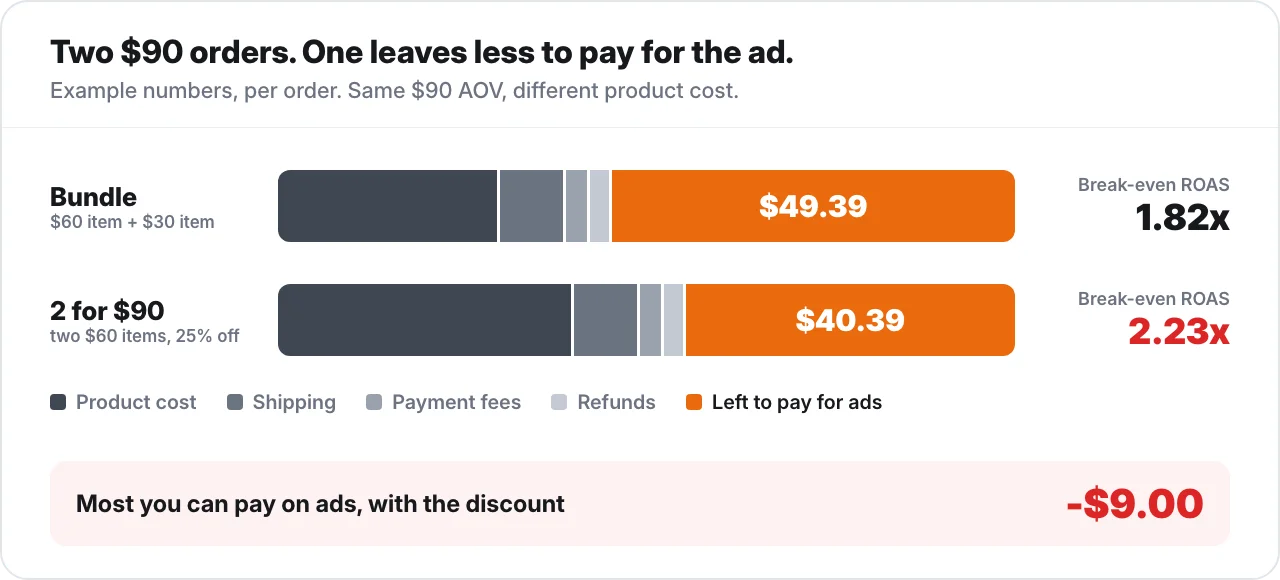
Now the caution. Say the $60 store runs "2 for $90" instead, which is 25% off two $60 items.
The AOV is $90, same as the bundle, but product cost is now $36, shipping $8, fees $2.91 and refunds $2.70, which leaves $40.39 per order (44.9%):
90 ÷ 40.39 = 2.23xThat's a break-even CPA of $40.39, $9 less room per order than the bundle, and a break-even ROAS of 2.23x, higher than the 1.99x the $60 store started with.
Both deals give you a $90 AOV, but only the bundle lowers the ROAS you need to break even, so check what a tactic does to your break-even CPA before you call it a win.
What is AOV? Quick answers to common questions
What does AOV stand for?
AOV stands for average order value, the average amount a customer spends per order. It means the same thing in marketing, in business and in ecommerce.
How do you calculate AOV?
Divide total revenue by the number of orders from the same period, so AOV = total revenue ÷ number of orders. A store with $30,000 from 500 orders has a $60 AOV.
Does AOV include shipping and tax?
It depends on the report. Shopify's sales reports leave tax and shipping out, while some other Shopify screens include them. For ad maths, use revenue before tax and handle shipping the same way every time.
What is a good AOV for ecommerce?
There's no universal number, because it depends on what you sell and what you charge. A good AOV is one that leaves enough per order to pay for the ad that got the order.
AOV vs ROAS: what's the difference?
AOV is revenue per order, and ROAS is revenue per $1 of ad spend. Your AOV and your costs set the ROAS you need to break even, which is 1.99x for the $60 store.
Does a higher AOV mean I can spend more on ads?
Yes, as long as the margin comes with it: the $90 bundle order can pay up to $49.39 for a customer, the $60 order only $30.16.
Anyways, the reason one store can pay more for a customer than another selling the same kind of thing is that it has more left per order after its costs, and that starts with its AOV, which is why the $90 bundle store can pay $49.39 for a buyer the $60 store can only pay $30.16 for.
Put your own numbers into the ROAS calculator and you'll see where your store sits.